ICAO English in Arajet's Pilot Selection: What 633 Assessments Reveal
We analyzed 633 aviation English interviews of Arajet Captain and First Officer applicants. 79.5% reached ICAO Level 4 or higher, and comprehension was the criterion that held the most candidates back.
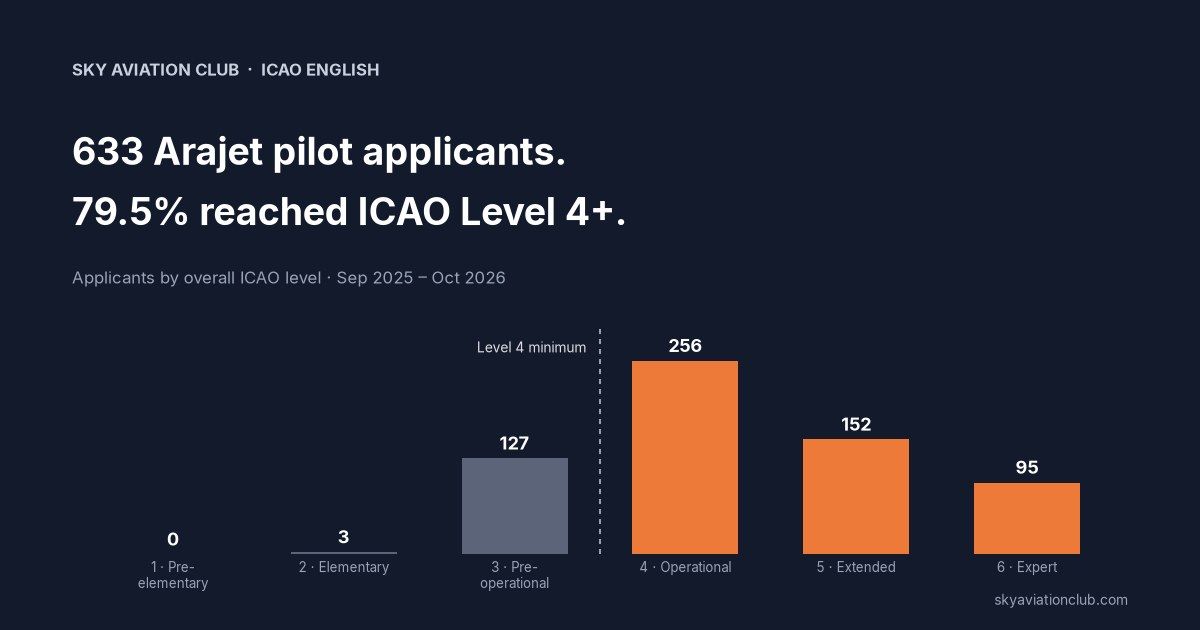
In short: Of 633 Arajet Captain and First Officer applicants assessed by Sky Aviation Club, 503 (79.5%) reached ICAO Level 4 or higher, the minimum for using English on international flights. The criterion that held back the most candidates was comprehension: it was below 4 for 73% of the 130 applicants who did not pass. Pronunciation, by contrast, was rarely the problem.
Since September 2025, Sky Aviation Club has administered the Arajet Knowledge and Situational Awareness English Assessment, the aviation English interview in the airline’s pilot selection process. This article summarizes what the aggregated, anonymized data shows, and what it means for any pilot preparing for an ICAO English assessment.
Key takeaways
- Eight in ten pass: 503 of 633 applicants (79.5%) scored Level 4 or higher. Average overall level: 4.33.
- Comprehension is the barrier: 95 of the 130 who did not pass (73%) scored below 4 on it.
- Fluency is the second weak point: 73 of the 130 (56%).
- Gap by position: Captains 87.0% pass rate; First Officers 75.3% (11.7 points lower).
- Many were close: 67 of those who did not pass fell short on only one or two criteria.
- 95 applicants (15%) reached Level 6 (Expert) and will not need to be re-evaluated.
What is Arajet’s English assessment for pilots?
The Arajet Knowledge and Situational Awareness English Assessment is an aviation English interview for Captain and First Officer applicants. It determines whether a candidate has the language proficiency Arajet’s selection process requires. Sky Aviation Club conducts and rates the interview using the CBTA competency matrix and the descriptors in ICAO Doc 9835.
The process started on September 15, 2025. This analysis covers the 633 assessments with a result, with interviews dated from December 10, 2025 to October 30, 2026. All data is aggregated: nothing that could identify a candidate is published.
How is the ICAO level calculated?
The ICAO language proficiency scale runs from 1 to 6. The assessor rates six criteria separately (pronunciation, structure, vocabulary, fluency, comprehension, and interactions), and the overall level is the lowest of the six, not the average. A single criterion at 3 puts the applicant at Level 3, even if the other five are at 5.
| Level | Name | What it means | ICAO-recommended re-evaluation |
|---|---|---|---|
| 1 | Pre-elementary | Cannot communicate in English in an operational context. | — |
| 2 | Elementary | Only memorized phrases and very simple situations. | — |
| 3 | Pre-operational | Manages routine situations but struggles with the unexpected. Below the minimum. | — |
| 4 | Operational | Minimum required to fly internationally. | Every 3 years |
| 5 | Extended | Confident, fluent communication, even in complicated situations. | Every 6 years |
| 6 | Expert | Proficiency comparable to a native speaker. | Not required |
If you are preparing for an ICAO assessment, see our ICAO language proficiency course.
How many applicants reached ICAO Level 4?
| Overall level | Applicants | % of total |
|---|---|---|
| 1 · Pre-elementary | 0 | 0.0% |
| 2 · Elementary | 3 | 0.5% |
| 3 · Pre-operational | 127 | 20.1% |
| 4 · Operational | 256 | 40.4% |
| 5 · Extended | 152 | 24.0% |
| 6 · Expert | 95 | 15.0% |
| Total | 633 | 100% |
The tallest column is Level 4: 256 applicants passed right at the minimum. Among those who did not pass, almost all (127 of 130) landed at Level 3: they handle routine exchanges but do not yet respond confidently to the unexpected. Almost no one scored Level 1 or 2.
The takeaway is clear: the group has an acceptable English foundation. The remaining work is not teaching from scratch. It is moving many applicants from 3 to 4, and consolidating those at 4 so they do not slip at their next evaluation.
Do Captains and First Officers perform the same?
No. 87.0% of Captain applicants passed, versus 75.3% of First Officer applicants: an 11.7 percentage-point gap. First Officers are the largest group (392 of those assessed), so their result moves the overall rate the most. The earliest assessments, when position was not recorded, had an 85.0% pass rate.
Captains have a higher average on all six criteria, but the gap is not even:
| Criterion | Average gap, Captain vs. First Officer |
|---|---|
| Comprehension | +0.38 (4.91 vs. 4.54) |
| Interactions | +0.18 |
| Fluency | +0.16 |
| Structure | +0.13 |
| Pronunciation | +0.13 |
| Vocabulary | +0.12 |
The First Officer gap is in understanding and responding, not in how they sound. A likely explanation is that Captains have spent more years using English on the radio.
Which ICAO criterion holds back the most candidates?
Among the 130 applicants who did not pass, these are the criteria that fell below 4. A candidate can fall short on several, so percentages add up to more than 100%.
| Criterion below 4 | Did not pass | % of those who did not pass |
|---|---|---|
| Comprehension | 95 | 73% |
| Fluency | 73 | 56% |
| Structure | 54 | 42% |
| Vocabulary | 53 | 41% |
| Interactions | 53 | 41% |
| Pronunciation | 17 | 13% |
In practice, weak comprehension means difficulty understanding controller instructions or unexpected messages, including unfamiliar accents and non-routine topics. These applicants find it harder to understand what is said to them than to make themselves understood.
The full score distribution confirms the pattern: almost no one scored 1 or 2, and scores of 3 cluster in comprehension (93) and fluency (72), while pronunciation has only 17.
| Criterion | 1 | 2 | 3 | 4 | 5 | 6 |
|---|---|---|---|---|---|---|
| Pronunciation | 0 | 0 | 17 | 250 | 207 | 159 |
| Structure | 0 | 1 | 53 | 232 | 196 | 151 |
| Vocabulary | 0 | 1 | 52 | 225 | 199 | 156 |
| Fluency | 0 | 1 | 72 | 208 | 205 | 147 |
| Comprehension | 0 | 2 | 93 | 195 | 177 | 166 |
| Interactions | 0 | 0 | 53 | 207 | 196 | 177 |
How close were the applicants who did not pass?
Closer than it looks. Of the 130 who did not pass:
| Criteria below 4 | Did not pass |
|---|---|
| 1 | 22 |
| 2 | 45 |
| 3 | 35 |
| 4 | 17 |
| 5 | 6 |
| 6 | 5 |
67 applicants (more than half) are one or two criteria away from Level 4. Only 5 scored below 4 on all six. Most do not need a full course, just targeted reinforcement. The 22 who fell short on a single criterion (in 11 cases, comprehension) have the best outlook for a second interview.
One more data point: 211 applicants (33.3%) received the same score on all six criteria. That signals even proficiency: no strong criterion paired with a weak one, but balanced performance at their level.
How should you prepare for an airline ICAO English assessment?
The data from this process points to concrete priorities:
- Train your listening, not just your speaking. Practice with real radiotelephony audio, with background noise and varied accents. This is where most candidates fall short.
- Work on fluency. Speak at a natural pace without long pauses, especially when the situation goes off-script.
- Prepare for the unexpected. The jump from Level 3 to Level 4 is responding confidently to non-routine events: an emergency, a changed clearance, a misunderstanding you need to resolve.
- If you are a First Officer, strengthen comprehension and interactions. That is where the gap with Captains is largest.
- If you are already at Level 4, do not get comfortable. More than half of those who passed landed right at the minimum; consolidating that level avoids surprises at your next re-evaluation.
Before paying for any test, also confirm with the authority or airline that requires it which tests it accepts.
ICAO English assessment for airlines
Sky Aviation Club administers aviation English assessments for airline selection processes, with reporting by level, criterion, and position like the one summarized here. If your airline or organization needs to assess its pilots, see our airline services or contact us.
Method note: figures were calculated from the process’s assessment sheet (644 records, 633 with a result). An applicant passes with an overall level of 4 or higher, where the overall level is the lowest of the six ICAO criteria. Recording inconsistencies (out-of-sequence dates, miscalculated overall levels, duplicate rows) were corrected before calculating. The results describe this group of applicants and should not be generalized to all pilots in the region.
Frequently asked questions
What ICAO English level does Arajet require for pilots?
In this assessment, an applicant passes with an overall ICAO level of 4 (Operational) or higher. Level 4 is the ICAO minimum for radiotelephony communications on international flights. Other stages and requirements of the selection process are set by Arajet.
How many Arajet pilot applicants passed the English assessment?
Of 633 applicants assessed, 503 (79.5%) reached ICAO Level 4 or higher: 256 at Level 4, 152 at Level 5, and 95 at Level 6. The other 130 (20.5%) scored Level 3 or below; 127 of them at Level 3.
How is the overall ICAO level calculated?
The assessor rates each of the six ICAO criteria from 1 to 6: pronunciation, structure, vocabulary, fluency, comprehension, and interactions. The overall level is the lowest of the six, not the average. A single criterion at 3 puts the applicant at Level 3.
What is the most common reason pilots fail an ICAO English assessment?
Comprehension. In this assessment, 73% of those who did not pass (95 of 130) scored below 4 in comprehension. Fluency was the second weak point (56%). Pronunciation was rarely the problem: only 13% of those who did not pass fell short on it.
Do Captains and First Officers score differently?
Yes. 87.0% of Captain applicants passed, compared with 75.3% of First Officer applicants, an 11.7 percentage-point gap. The biggest difference between the two groups is in comprehension (average 4.91 vs. 4.54).
How often do pilots need to retake the ICAO English assessment?
ICAO recommends re-evaluating Level 4 holders at least every 3 years and Level 5 holders at least every 6 years. Level 6 (Expert) does not require re-evaluation. Each State sets its own schedule.
Sources and scope
Aggregated, anonymized results of the Arajet Knowledge and Situational Awareness English Assessment, administered by Sky Aviation Club since September 15, 2025. Covers 633 assessments with a result (dated December 10, 2025 through October 30, 2026). It contains no personal candidate data and does not describe other stages of Arajet's selection process.
- ICAO Doc 9835 — Manual on the Implementation of ICAO Language Proficiency Requirements
- ICAO Annex 1 — Personnel Licensing
- ICAO — Language Proficiency Requirements (LPR)
- Arajet — official site
Last verified: November 7, 2026. This article is general information, not legal, immigration, or financial advice.